Eight websites, ten dimensions,
one structural argument
for TP-Link.
A source-level read of how Apple, Eero, DJI, Samsung, Toyota, Google Nest, 360 and Insta360 organize their websites — captured as screenshots, sitemap inventories, DOM nav graphs and SEO/AI-indexability signals — and translated into a current-state audit and recommended IA for the TP-Link US redesign launching at CES 2027.
Five things that surfaced
Cross-brand patterns the redesign should treat as evidence, not opinion. Each is grounded in measurable source-level signals across at least three of the eight sites studied.
- TP-Link's IA is structurally biased toward support. Of TP-Link US's 4,359 indexable URLs, 2,471 (57%) live under
/support/; includinguser-guides,configuration-guidesanddocumentthe figure climbs to ≈ 70%. Eero's entire indexable inventory is 48 URLs. The PRD's "43–50% of traffic goes to Support" finding is not a user-preference observation — it is what the IA itself biases toward.data: tp-link.com/us/sitemap.xml · eero.com/sitemap.xml - Top-nav lean is the single sharpest separator. Eero exposes 24 navigational links; TP-Link exposes 263. Apple uses 275 but routes them through one mega-menu structure. The story-led brands collapse to a flat 4–6 primary categories; the SKU-led brands explode link counts in the chrome and bury the brand.DOM:
document.querySelectorAll('header a, nav a').length - TP-Link's HTML has zero modular structure. The homepage uses
<section> = 0,<article> = 0,<aside> = 0— only one<main>. Samsung uses 12<section>blocks; Nest uses 75 sections + 78 articles. Without semantic chunking, both LLM crawlers and assistive tech read TP-Link as a single undifferentiated blob.DOM extract per site - llms.txt is the new robots.txt — and only Eero and Samsung have shipped it. 2 of 9 sites studied serve a valid
llms.txt. Eero's is 30 lines of plain marketing prose; Samsung's is a structured directory of regional sites. TP-Link returns 404. Cost-to-implement: one text file. Ship-by-CES probability: trivial.curl /llms.txt across 9 sites - TP-Link's robots.txt declares the Netherlands sitemap as canonical.
https://www.tp-link.com/robots.txtcurrently listsSitemap: https://www.tp-link.com/nl/sitemap.xml. The US sitemap exists at/us/sitemap.xml(1 MB, 4,359 URLs) but is undeclared, hurting Google and LLM crawl coverage on the highest-revenue locale.curl https://www.tp-link.com/robots.txt
Methodology
Three layers of capture per site, run in parallel from a controlled environment on 2026-05-13. Every claim in this report can be reproduced from the captured data folder.
Brands studied
Eight competitors plus TP-Link itself. Each card jumps to its IA walkthrough. TP-Link's card is highlighted because it is both the subject and the benchmark.
<nav> element.<section> · no llms.txt · sitemap declared as /nl/ in robots.Structural matrix
Hard signals only — counts and presence flags pulled from sitemap.xml, DOM, and HTTP responses. This is the table that should drive Discovery Readout discussion. TP-Link row highlighted.
| Brand | Indexable URLs | Top-nav links | Semantic tags (sec / art / aside) |
JSON-LD types | llms.txt | Detected stack | Site-wide chat | Hero strategy |
|---|---|---|---|---|---|---|---|---|
Apple apple.com |
846 depth 1–6 |
275 mega-menu |
5 / 0 / 1 | Organization · WebSite · WebPage | ✗ | custom | ✓ support-scoped | Single-product, brand-led |
Eero eero.com |
48 flat |
24 4 categories |
2 / 4 / 0 | FAQPage · WebPage | ✓ | Next.js | ✓ | Editorial copy + 1 product |
DJI dji.com |
37× sitemap-index |
78 flat top-bar |
6 / 0 / 0 | — | ✗ | custom | ✓ | Single product hero |
Samsung samsung.com/us |
97× country index |
185 mega-menu |
12 / 0 / 0 | Corporation · WebSite · WebPage | ✓ | custom | ✓ | Single product (Galaxy S26) |
Toyota toyota.com |
76 marketing only |
272 mega-menu |
5 / 1 / 0 | WebPage | ✗ | custom | ✓ | Carousel + EV family |
Nest store.google.com |
36× country index |
0 no <nav> |
75 / 78 / 221 | Organization | ✗ | custom (Google) | ✗ | Brand line + product grid |
360 (Qihoo) 360.cn |
— no sitemap |
0 484 raw <a> |
0 / 0 / 0 | — | ✗ | legacy | ✗ | Promo grid |
Insta360 insta360.com |
— CF blocked |
— | — | — | ✗ | Angular | ✓ | Lifestyle hero needs verification |
TP-Link tp-link.com/us |
4,359 70% support |
263 multi-brand |
0 / 0 / 0 | WebSite | ✗ | legacy CMS | ✓ Areal | Tapo promo + camera SKU |
Apple
apple.com●●●●●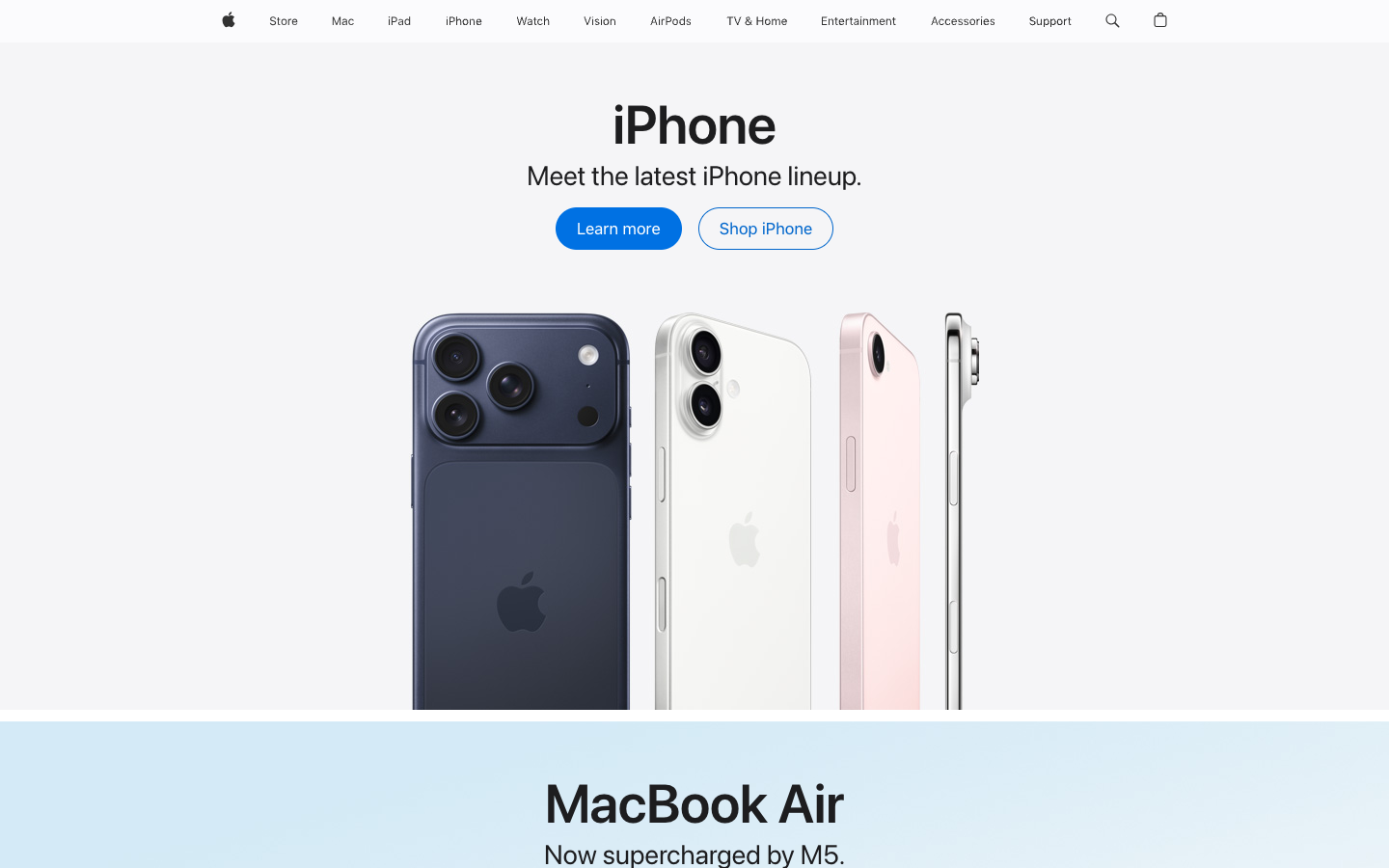
- Indexable URLs
- 846
- Top-nav links
- 275 (mega-menu)
- Schema types
- 3 (Org, Site, Page)
- llms.txt
- 404
IA walkthrough
Eero
eero.com●●●●●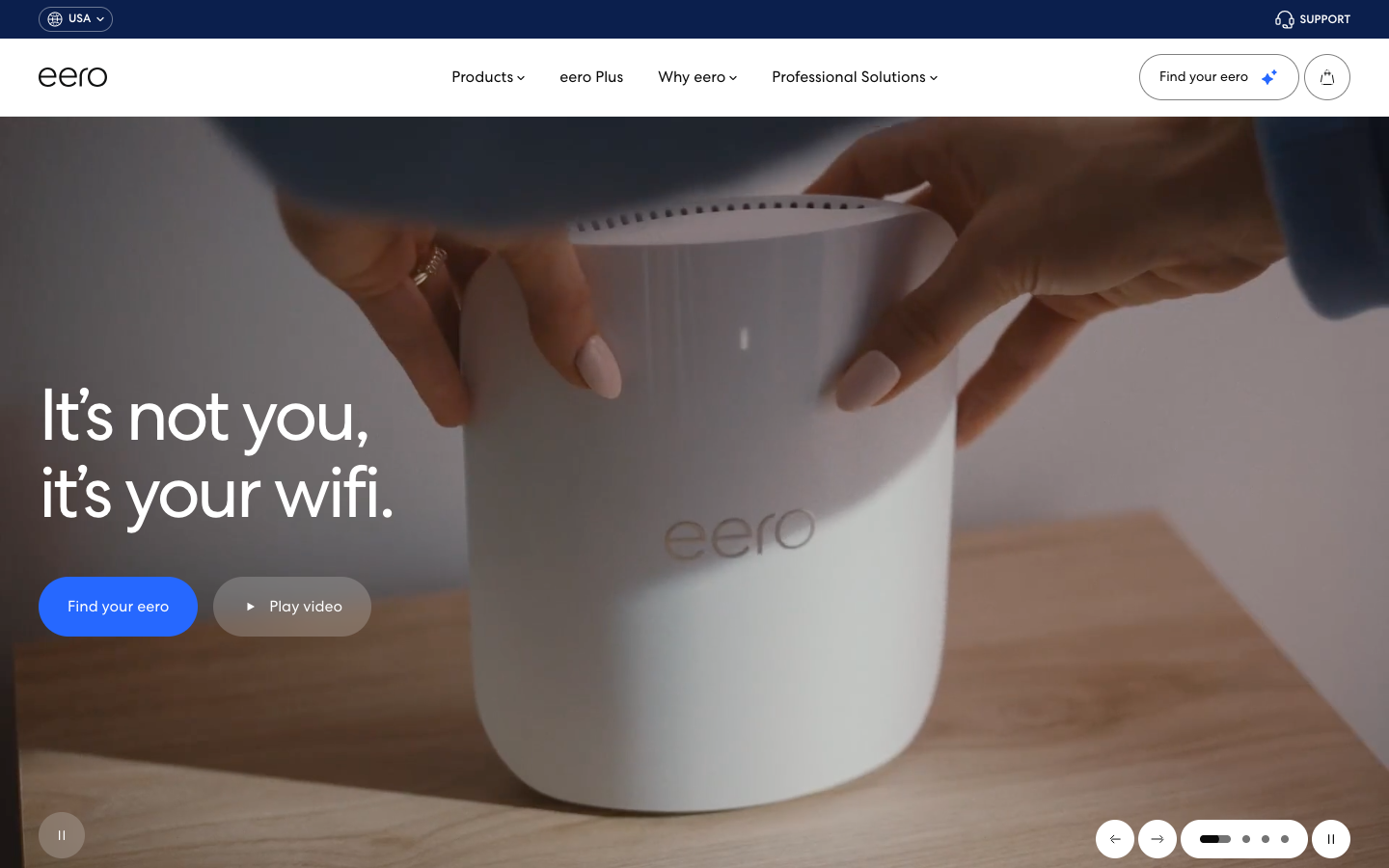
- Indexable URLs
- 48
- Top-nav links
- 24 (4 primary)
- Schema types
- FAQPage, WebPage
- llms.txt
- 200 · 30 lines
IA walkthrough
/shop/ holding 15 (the product line), /legal/ nine, and three whitepapers. Every product page is one click from the homepage. The hero ("It's not you, it's your wifi.") is a brand statement, not a product pitch.Standout pattern
support.eero.com), keeping it out of the main IA inventory. This is the inverse of TP-Link's structure, where support dominates 70% of the catalog and intercepts the brand journey.DJI
dji.com●●●●○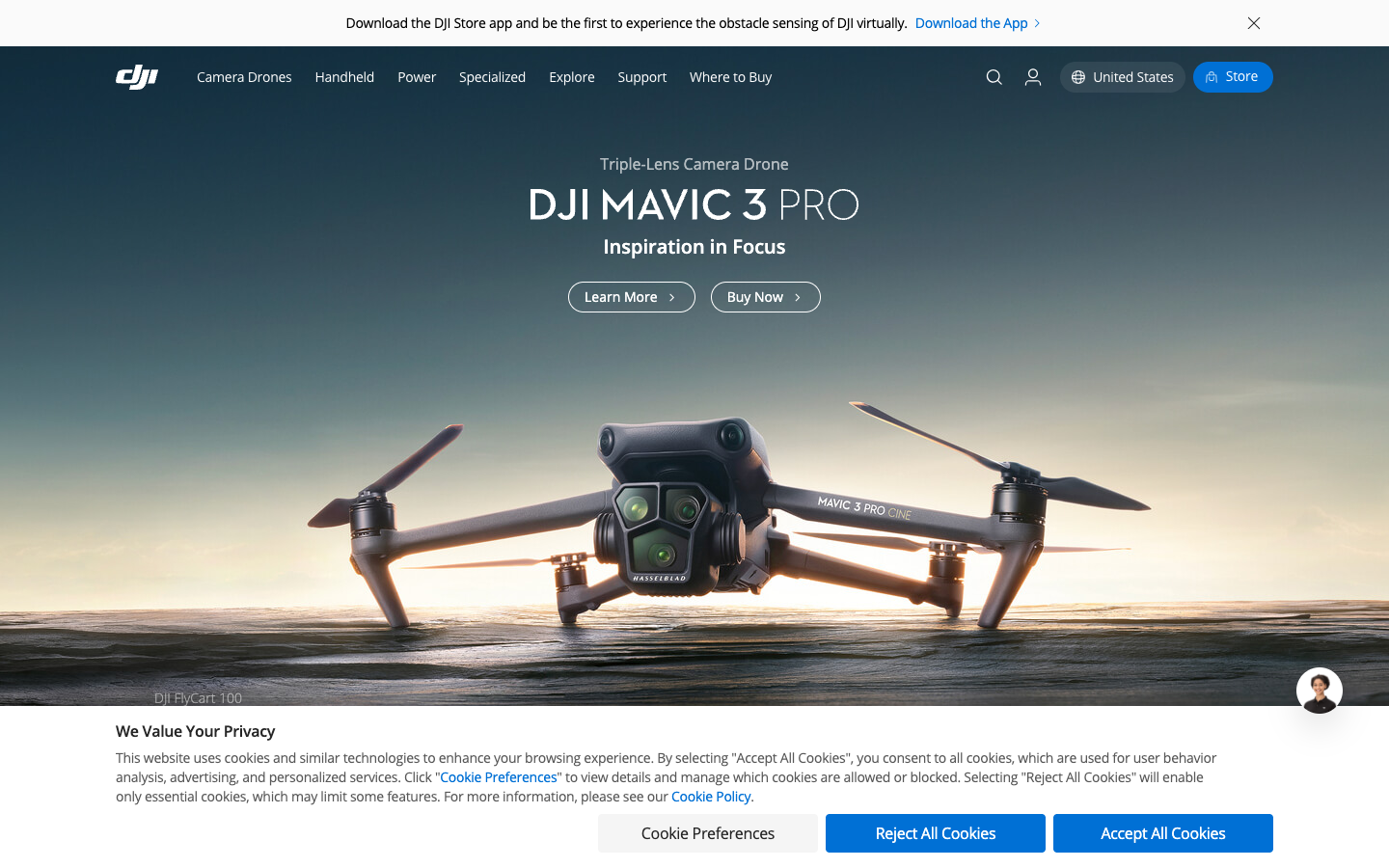
- Indexable URLs
- 37 sub-sitemaps
- Top-nav links
- 78
- Schema types
- none
- llms.txt
- 404
IA walkthrough
sitemap-index — a useful pattern for a catalog the size of TP-Link's.sitemap-index as the canonical pattern: one index, sub-sitemaps for products / support / press / blog. Lets crawlers parallelize without each section bleeding into the others' inventory.
Samsung
samsung.com/us●●●●○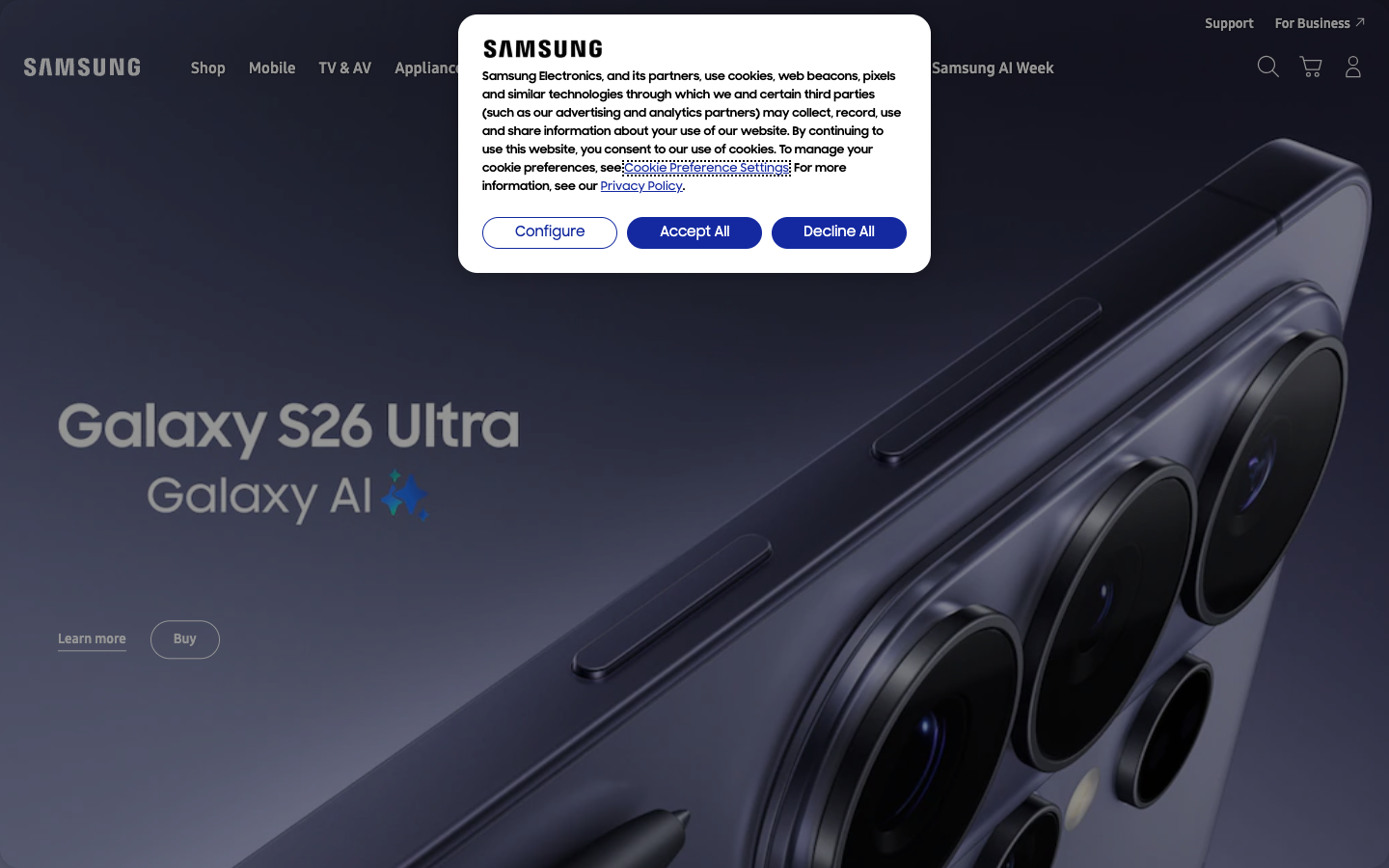
- Indexable URLs
- 97 country sitemaps
- Top-nav links
- 185 (mega)
- Schema types
- 3 incl. Corporation
- llms.txt
- 200 · regional index
IA walkthrough
<section> blocks on the homepage signal heavy modular structure. llms.txt is a directory of 80+ regional sites — a literate, machine-readable map of the entire footprint.Toyota
toyota.com●●●○○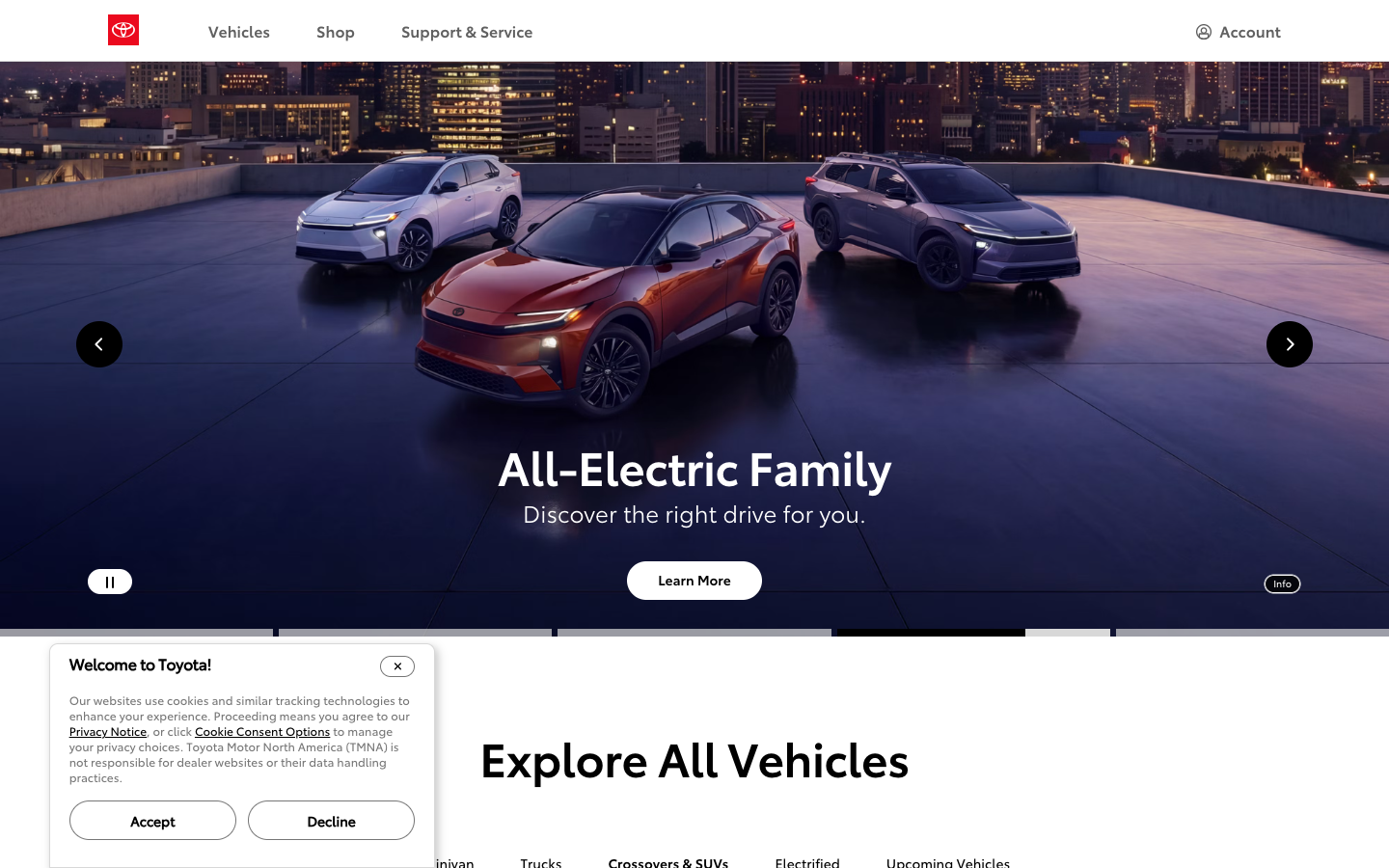
- Indexable URLs
- 76 (marketing)
- Top-nav links
- 272
- Schema types
- WebPage
- llms.txt
- 404
IA walkthrough
Google Nest
store.google.com/category/google_nest●●●●○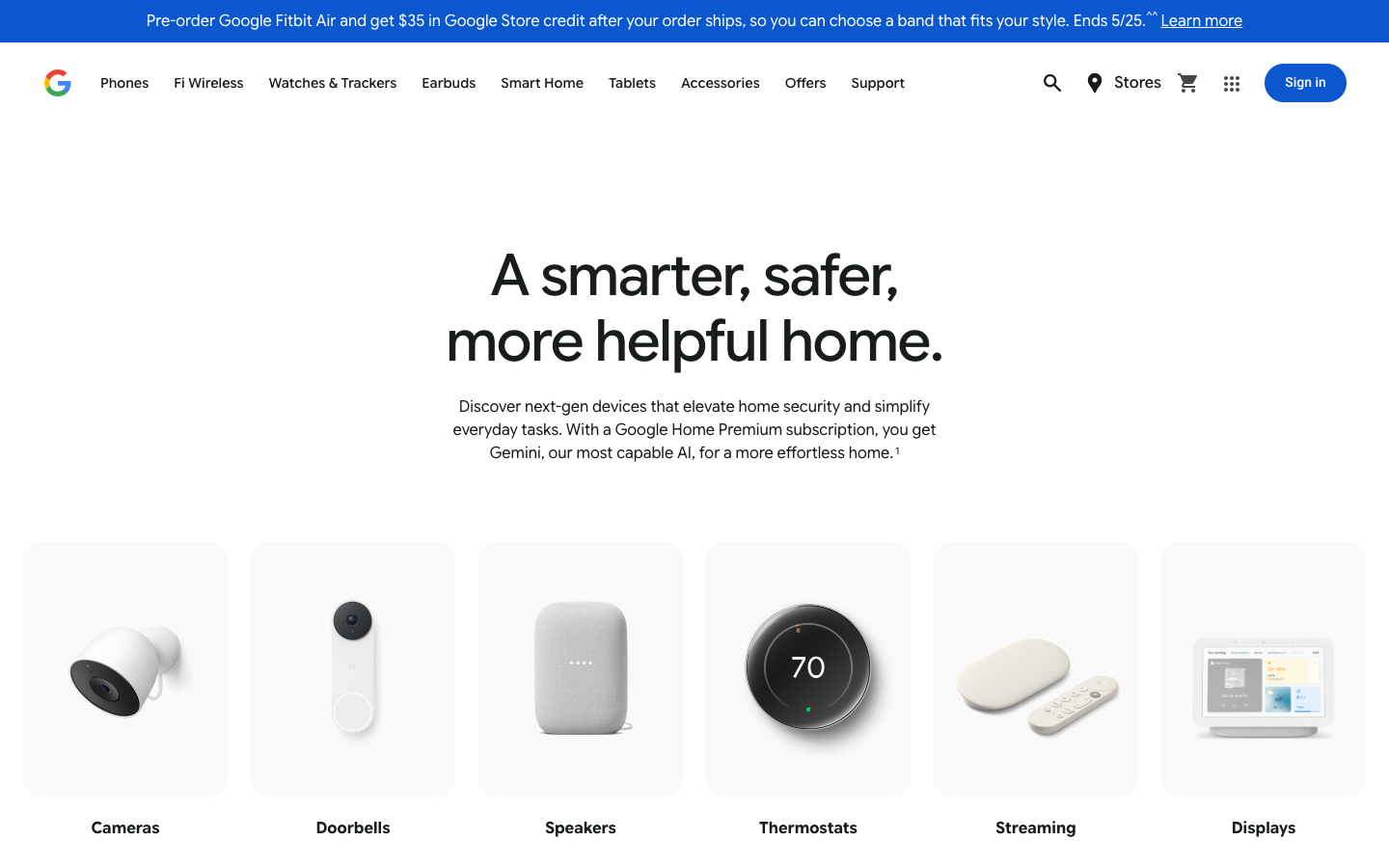
- Indexable URLs
- 36 country sitemaps
- Top-nav links
- 0 (router-driven)
- Schema types
- Organization
- llms.txt
- 404
IA walkthrough
<section> and 78 <article> tags — extreme modular structure that supports machine reading despite zero <nav> elements (chrome is via Google Store header).<section>/<article> markup is a machine-readability pattern, not just a styling exercise.
360 (Qihoo)
360.cn●○○○○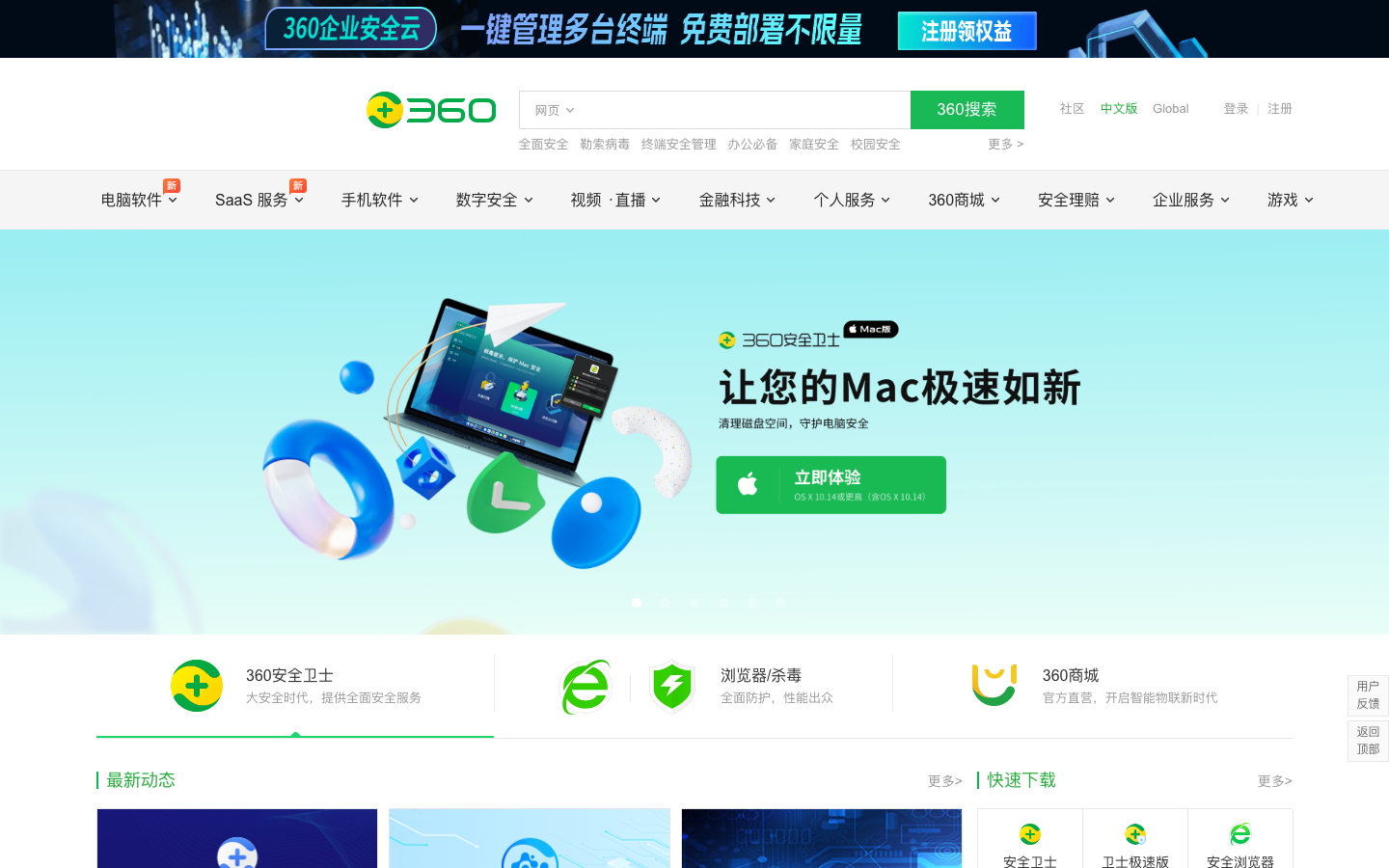
- Indexable URLs
- no sitemap declared
- Top-nav links
- 0
<nav>· 484<a> - Schema types
- none
- llms.txt
- 404
IA walkthrough
<nav>, no <header>, no <section>) and 484 raw anchor tags arranged as a promo grid. There is no machine-readable sitemap. The visual experience is dense product cards and corporate enterprise links interleaved without hierarchy.Insta360
insta360.com●●●○○ partial
- Indexable URLs
- CF blocked
- Top-nav links
- CF blocked
- Schema types
- —
- Detected stack
- Angular
IA walkthrough
TP-Link · Current state
tp-link.com/us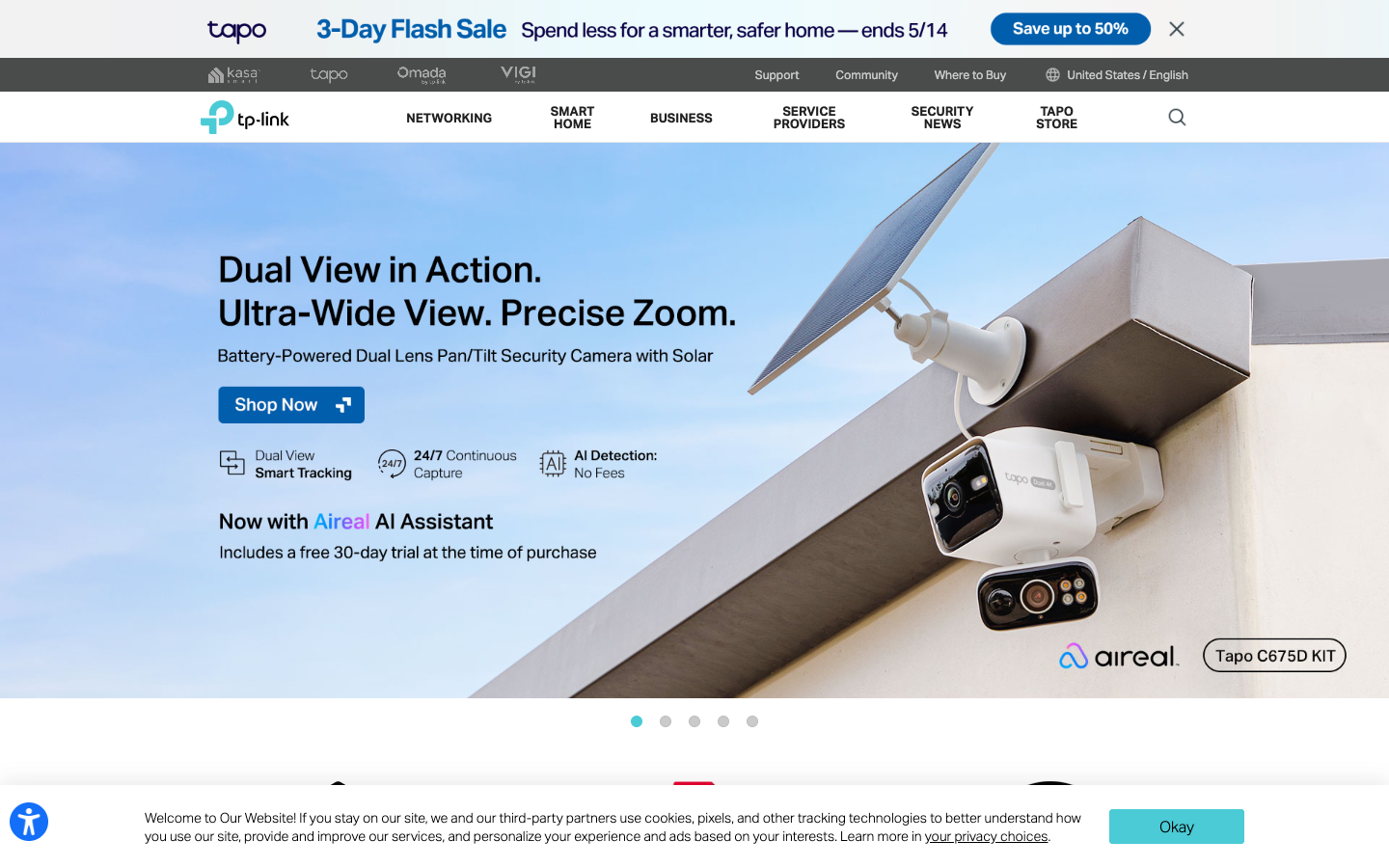
What the homepage actually communicates in the first 5 seconds
Sitemap inventory: where the 4,359 indexable URLs actually live
Parsed from https://www.tp-link.com/us/sitemap.xml (1.0 MB, 4,359 URLs). Top-15 path prefixes shown — categories below 8 URLs omitted.
/about-us/, /technology/) total 25 URLs — 0.6% of the indexable inventory. The site, by URL count, is a support portal that sells routers on the side.
IA tree (current, top three levels)
TP-Link · Source-level audit
HTML / robots / schemaSemantic HTML
<header> = 1, <nav> = 2, <main> = 1, <footer> = 1. It uses zero <section>, zero <article>, zero <aside> tags. By comparison Samsung uses 12 <section> blocks on the equivalent page; Nest uses 75 sections + 78 articles. For LLM crawlers and assistive technology the absence of these chunk markers means the page reads as one undifferentiated content block — they cannot resolve "the hero", "the product grid", "the AI section" as separable units.Schema.org markup
"@type": "WebSite". There is no Organization entity (which Apple and Samsung both expose with logo, founder, and contact fields), no Product markup on the homepage product card, and no FAQPage markup despite a Tapo / Areal Q&A presence. Schema is the primary way Google, Bing, and increasingly LLM agents understand what kind of entity this brand is.Crawl declarations
https://www.tp-link.com/robots.txt currently declares the canonical sitemap as https://www.tp-link.com/nl/sitemap.xml — the Netherlands locale. The actual US sitemap exists at /us/sitemap.xml (4,359 URLs) but is undeclared. There is no llms.txt at the root (404) — versus Samsung and Eero, both of whom serve a valid one. There is no sitemap-index.xml: the site emits one monolithic XML rather than the segmented index DJI uses.Sitemap: https://www.tp-link.com/us/sitemap.xml to /robots.txt.2. Publish
/llms.txt at root — 30 lines describing brand, product lines, audience, support model. (Eero pattern.)3. Add
Organization JSON-LD with logo, founding, address, contact, social handles. (Apple pattern.)
Mobile
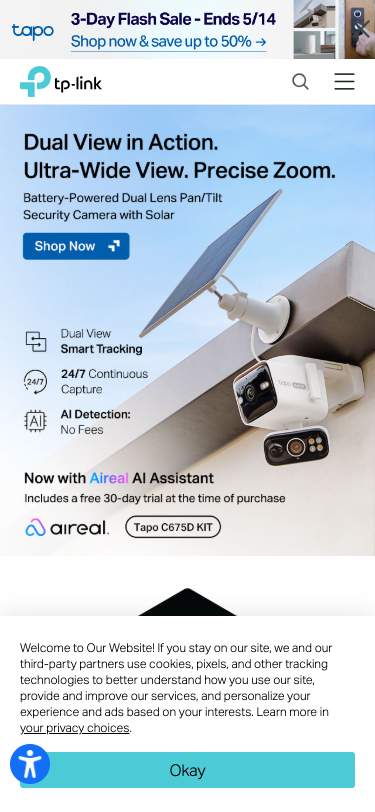
Adoption matrix
competitor pattern → TP-Link decisionEach competitor pattern is one row. Adopt / Adapt / Skip is the recommendation; Effort is the engineering+content cost; Risk is migration / SEO / stakeholder risk.
| Pattern | From | For TP-Link | Decision | Effort | Risk |
|---|---|---|---|---|---|
| Single-product brand-led hero with ≤2 CTAs | apple.com eero.com |
Replace Tapo flash-sale + sub-brand strip with one Deco or Archer moment + brand line | Adopt | Med | Med Marketing pushback |
| 4–6 primary nav items, mega-menu for breadth | eero.com apple.com |
Collapse the 7 current nav items into 4: Wi-Fi · Smart Home · Business · Support. Sub-brands live inside mega-menus, not in the chrome. | Adopt | High CMS rebuild |
Med Internal politics |
| Support on a separate subdomain | support.eero.com | Move /us/support/ to support.tp-link.com. Removes 70% URL pollution from the brand IA without losing content. |
Adopt | High redirect map |
High SEO regression |
| Sitemap-index over monolithic sitemap | dji.com samsung.com |
Split /us/sitemap.xml into products.xml, support.xml, press.xml, blog.xml. Add an index. |
Adopt | Low CMS export |
Low |
Semantic <section>/<article> chunking |
samsung.com nest.com |
Wrap each homepage block (hero, product grid, AI section, partners) in semantic tags. Required for AI-indexability KPI in PRD §2.3. | Adopt | Low template change |
Low |
| llms.txt at root | eero.com samsung.com |
Publish a 30-line brand/product description at /llms.txt. CES-ready, no engineering cycles. |
Adopt | Low copywriting |
Low |
| Organization + Product JSON-LD | apple.com samsung.com |
Add Organization, WebSite, Product schema to homepage and PDPs. |
Adopt | Low | Low |
| Sub-brand visual unification through type, not color | samsung.com dji.com |
Solves PRD §2.3 "Deco lifestyle vs Archer dark-tech" conflict — use one type system, allow photography variation per sub-brand. | Adopt | Med design system |
Med brand alignment |
| Site-wide AI shopping assistant in chrome | tp-link (Areal) insta360, 360 |
Areal already exists — keep it but elevate to chrome-level placement (not embedded in product card). | Adapt | Low | Low |
| Brand line above product grid on category pages | nest.com | "A smarter, safer, more helpful home." pattern — single brand line, then product-type grid. Apply to /smart-home/ as Tapo replacement landing. |
Adopt | Low | Low |
| Carousel hero with rotating campaigns | toyota.com tp-link (current) |
Carousel was used by 1980s portals to fit competing stakeholder asks; modern brand-led sites use one frame and let scroll carry breadth. | Skip | — | — |
| "Everything visible in chrome" portal | 360.cn | The current TP-Link pattern, rejected. | Skip | — | — |
Recommended IA · v1
tp-link.com/us · CES 2027 targetSynthesis of the eight competitor patterns mapped onto TP-Link's actual product portfolio. Discovery Readout decision target. Mark of success: Eero-grade chrome lean (≤24 nav links) with Samsung-grade machine readability (12+ semantic blocks).
Proposed top-level chrome (4 primary, 1 utility)
Per-template rules (modular CMS prep)
| Template | Hero rule | Semantic blocks (min) | Schema | AI placement |
|---|---|---|---|---|
| Homepage | 1 product moment + 1 brand line, 2 CTAs max, no carousel, no promo bar | 5 <section>: hero, brand-prove, category-grid, ai-band, footer-bridge |
Organization, WebSite, ItemList | Search bar = Areal entry |
| Category (e.g. /wifi/) | Brand line + product-type grid (Nest pattern) | 1 hero + 1 grid + 1 compare + 1 spec-band | ItemList, BreadcrumbList | "Help me choose" → Areal |
| PDP | 1 product image, 1 spec block, 1 buy band, 1 compare CTA | 5+: hero, specs, in-the-box, compare, support-bridge | Product, Offer, AggregateRating | "Ask about Deco BE65" → Areal |
| Campaign (Wi-Fi 8 / CES) | Editorial layout, long-scroll, single narrative arc | ≥6 sections (chapter pattern) | Article, BreadcrumbList | End-of-page Areal CTA |
| Landing (sub-theme) | Topic introduction → product bridge | 3+ sections | WebPage, BreadcrumbList | Sidebar Areal trigger |
Click-path target vs current
Five quick wins TP-Link can ship before Discovery Readout
All five are source-level fixes — no design system, no CMS migration. Each is reversible and would survive into v1 of the redesign.
Sitemap: https://www.tp-link.com/us/sitemap.xml to /robots.txt. Currently declares Netherlands sitemap. Immediate Google + LLM crawl coverage on the highest-revenue locale.<section>products.xml, support.xml, press.xml, blog.xml. DJI / Samsung pattern. Lets crawlers parallelize, isolates sections.Appendix
Captured data
All raw captures stored under the project's data/<brand>/ and screenshots/ folders. Each brand has: index.html (raw), sitemap.xml, robots.txt, llms.txt (or 404 marker), headers.txt, dom_extract.json. Capture date 2026-05-13.
Tools
curl for source-level capture (parallel, 8 workers). agent-browser (Playwright/CDP) for screenshots and DOM extraction. python3 for sitemap parsing. No external services. All artifacts reproducible from the scripts in scripts/.
References
- TP-Link US Website Redesign · PRD v0.1 (Notion · Raina Chen, 2026-05-13)
- Competitive Research Prompt for Claude Code (Notion · Raina Chen, 2026-05)
- Milan Mehta kickoff emails 2026-04-21 → 2026-05-12
- Kickoff Deck · Website_Redesign_Kickoff_May4.html (SharePoint)
Open questions for Discovery Readout (5/22)
- Decoupling Support to a subdomain: SEO regression vs IA gain — what is Elena's risk read?
- Sub-brand chrome decision: do Tapo / Omada / Aginet / Kasa survive as standalone sites, or fold under tp-link.com/us with mega-menu? (Affects Marketing org structure.)
- Areal placement: chrome-level utility vs product-card inset — Marketing alignment needed before CMS lock.
- Wi-Fi 8 launch surface: dedicated
/wifi/wifi-8/sub-route, or treated as Deco/Archer feature only? - Carousel: kill it, or retain for Marketing campaign rotation? (Recommendation here is kill; needs PJ alignment.)